BIRDLIME > RESOURCES > OAK IDENTIFICATION > BLACK OAK
Black oaks are the joker in the red oak pack. If you don’t have any buds or leaves in front of you, identification may feel like a crapshoot – Quercus velutina has indistinct bark, a reasonably wide range of habitat conditions, and no particularly noticeable quirks of growth or form. The species is, however, one of few oaks whose buds are so distinct that they should be the first detail to be examined. Q. velutina buds are the largest, fuzziest, palest buds you can find, comparable only to those of scarlet oak, Q. coccinea.
Where Q. velutina differs, though, is a top-to-bottom coverage of hair, or pubescence.
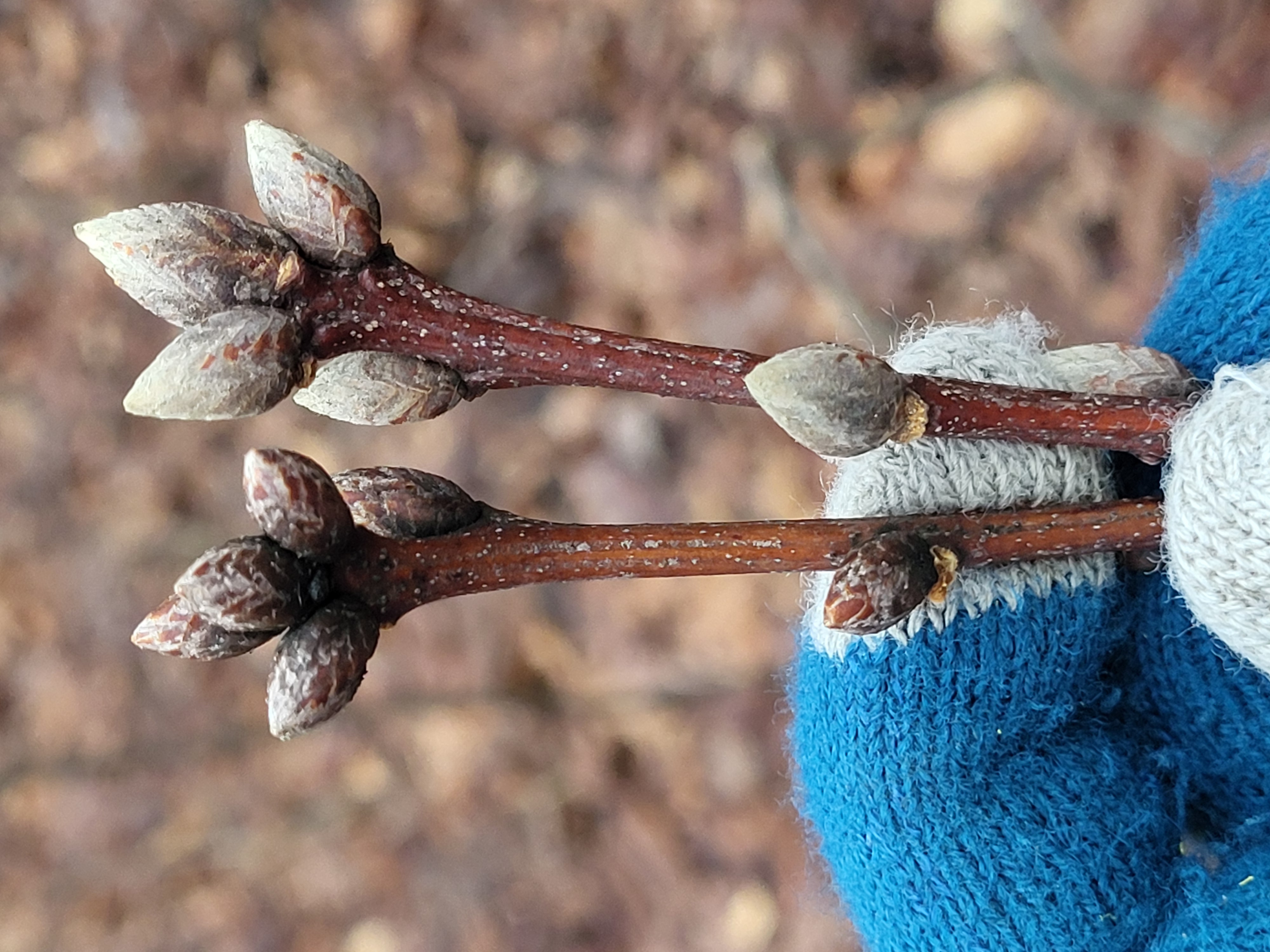
Quercus coccinea, the scarlet oak, has partially pubescent buds on an orange-to-brown twig (left) while Quercus velutina, the black oak, has totally pubescent buds, white or cream-colored, on a typically maroon twig.
Leaves can present a challenge. While black oak leaves have a particular distinguishing shape (namely, two large penultimate lobes which flare out wider than its base – making them a bit like the red oak group’s answer to post oak leaves), the leaves of the black oak are quite variable and can be difficult to distinguish from scarlet, Shumard, or even northern red leaves at times. Pay attention to the U-shaped sinuses, shaped like the space between your thumb and your index finger – northern red leaf sinuses will more closely resemble the narrower, V-shaped space between your index and middle fingers, while Shumard leaf sinuses rather resemble the silhouettes of hitchhiker’s thumbs, being “pinched off” around where the second knuckle would be.
Here, again, Q. velutina is potentially easy to confuse for Q. coccinea. Some more tips: Q. coccinea is an upland species, not so often found in mid-slope mesic areas where black oak may be. Q. velutina leaves are big, and sinuses rarely go as deep as Q. coccinea’s do toward the leaf midvein.
The acorn cupule is a good differentiator as well. Q. velutina’s acorns don a light-colored, grey-to-brown cap which covers a medium-sized nut. The scales on the rim of the cupule are typically “loose” and easy to flick off or peel away with a fingernail. Q. coccinea caps, on the other hand, are a bit larger, smoother, glossier, and ruddy than Q. velutina – as if a cap of the latter had been given a thick layer of wood varnish.