BIRDLIME > BLOGS > THE VENUS OF LESPUGUE
Ever since discovering that there are more Venus figurines than just Willendorf, I’ve been fascinated by them as pieces of art. I generally dislike the “death of the author” approach towards the interpretation of pieces of artwork, at least on its own. Prehistoric artwork, though, is definitionally without enough known context to draw any sure conclusions about who was making it, when, and why. We have educated guesses, nothing more, and these all seem to fall flat in front of these figurines.
That they are fertility idols is the most commonplace idea (and probably the one closest to the truth, in my own opinion), but even that raises further questions and assumptions. Were they meant to be religiously reverential to the ideals of fecundity and female maternity, or were they meant to be pornographic? Would there even be a difference between these two purposes to the people who made them?
One idea that has taken off is that they are “self-portraits” made by women viewing their own bodies in first-person. Catherine McCoid and LeRoy McDermott proposed this as far back as 1996, but it’s become particularly popular in recent years. Any carver doing this would inevitably de-emphasize their feet and legs and of course leave out facial features. A fun idea, but one that has gotten a fair bit of pushback from academics and others alike. It does have a whiff of girl-power revisionism to it. A more out-there theory is that they served not just as visual stimulation but physical as well.
Actually, there is probably not a greater disservice one can do to these figurines than attempt to apply a one-size-fits-all theory. To even lump them all together in a singular group suggests that there is a cultural connection between them that may simply not be there. The oldest among them is separated from the newest by a period of at least 20,000 years. 20,000 years!
The classic image that comes to mind is that of a big woman, cartoonishly exaggerated, with rounded bellies and secondary sexual characteristics (the word ‘pendulous’ surely gets no more use than when applied to these figures). This is the category which includes the famous Venus of Willendorf, the Venus of Moravany, and the haughty-seeming Venus of Hohle Fels. But there are other styles as well.
The Venus impudique is rather slender, featuring only a vulva as an emphasized sexual characteristic. The Venus of Monruz is shockingly modern-looking, the form of a figure bending their back outwards reduced to abstract curve and form. The figurines of Gönnersdorf go even further, basically appearing as triangular protuberances on poles. It seems almost to invite a degree of doubt that they are even meant to depict the female form, as has been the case with the even more ancient figurines of Tan-Tan and Berekhat Ram, which appear as largeish pebbles suggesting vaguely the appearance of a human body.
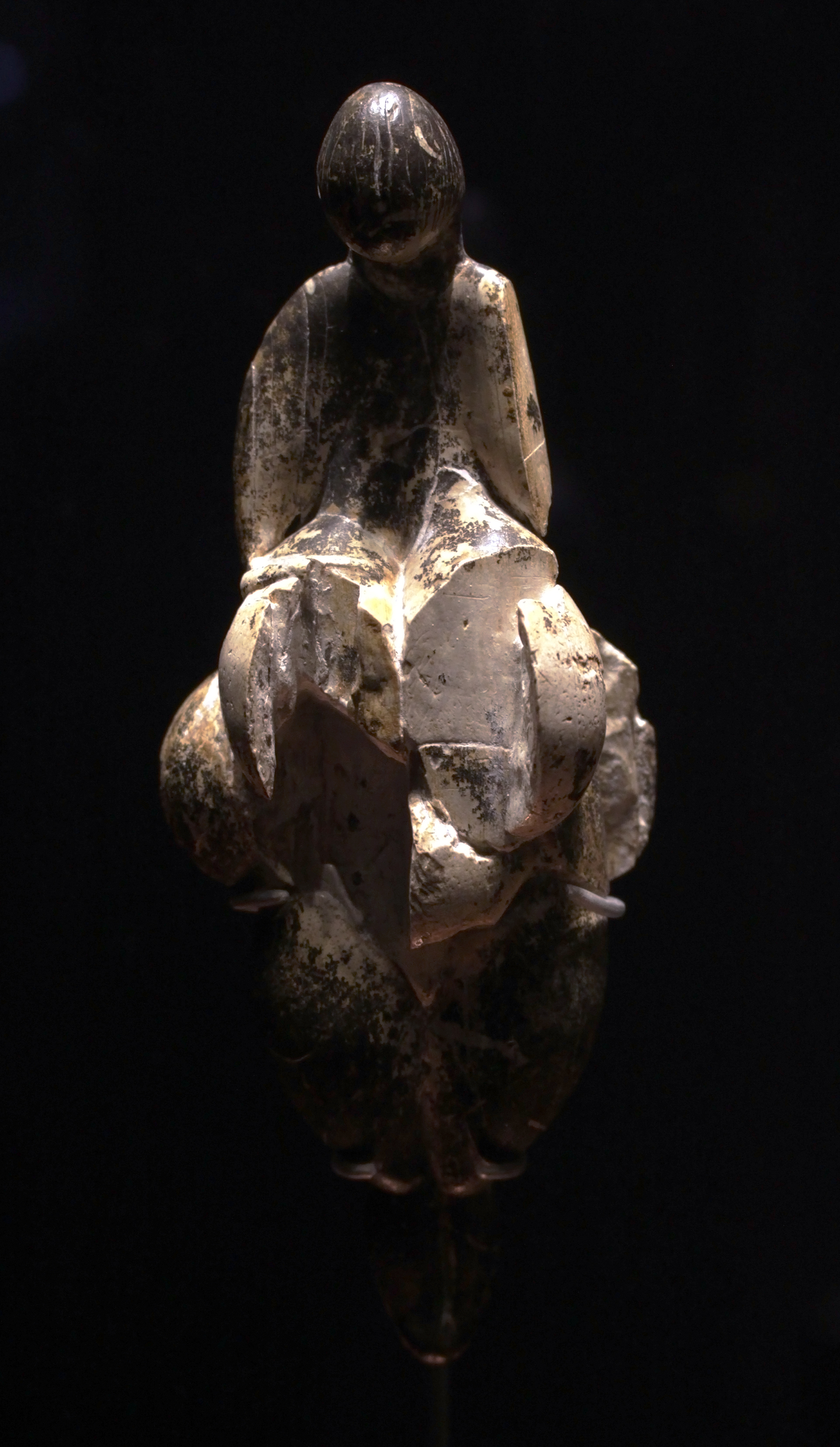
With all that said, let me get to the real point of this long-winded lead-up: I have always felt a sort of object-pity for the Venus of Lespugue. This figurine falls into the Willendorfian category and actually has perhaps the most outrageous proportions of any figurine yet discovered. Her breasts easily dwarf her head, taking up a third of the space on her figure, while her hips and buttocks appear oversized behind her. What you will find if you search for her image online is what she probably once looked like – intact, full, and round. But the original figurine itself was damaged during its discovery and is now preserved with chips and chunks of sharp rock fallen away from her body. Her slightly downturned head, with no face to speak of, seems to mutely contemplate her breasts, now broken and jagged, exactly the opposite of what they were once meant to celebrate. Her body, which she was, almost without question, primarily made for, has become cold, angular stone once again.