BIRDLIME > BLOGS > TWO EERIE LYNCH JUMP CUTS
This is a short post about two jump cuts in David Lynch’s filmography and how they reflect the unreality of their stories.
A jump cut is a sudden cut from a shot of a subject to another shot of the same subject. The anally retentive among us would perhaps describe the two scenes I’m about to describe as, strictly speaking, not jump cuts; in the first, the subject disappears in the second shot, and in the second, the subject appears again – but from a completely different angle. I’m going to refer to them as jump cuts.
In Blue Velvet, Frank Booth and his gang take young Kale to see Ben, a suave drug dealer who enjoys heavy makeup and heavy women. Following Ben’s performance of "In Dreams," Frank gets agitated and decides to continue the night’s festivities on the open road. With his gang of goons in tow, Frank announces “LET’S FUCK! I’LL FUCK ANYTHING THAT MOVES!” – a Boothian life philosophy if ever there was one. The shot of Frank, laughing, cuts to the same shot of the room, now emptied of Frank and company, accompanied by the squeal of car wheels.
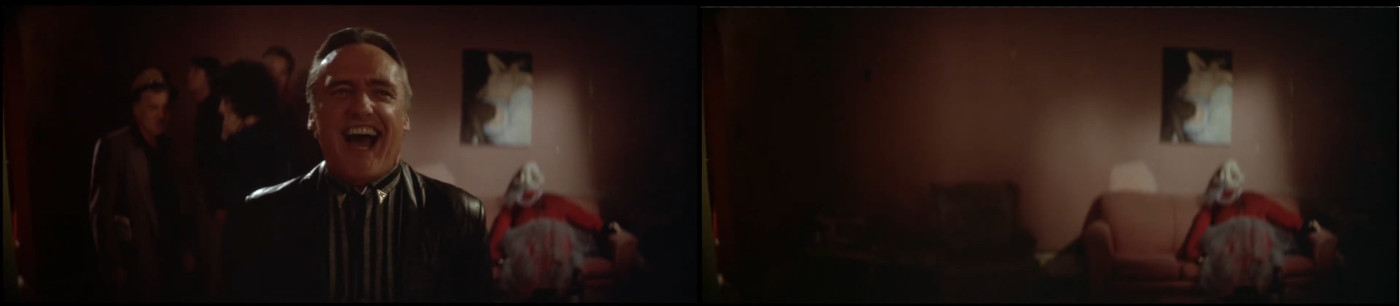
It's almost a reverse jumpscare. It’s the absence of those in the shot that is so affecting – the suddenness of it lends a hallucinatory and near-supernatural quality to Lumberton’s criminal underworld. Frank caught Jeffery almost literally with his pants down at Dorothy’s apartment, and in the ensuing scenes one disorienting and unexpected thing happens after another. The seemingly polite Ben sucker-punches Jeffery after gently speaking with him; Dorothy’s off-screen reunion with her kid appears to go suddenly sour in ways we can only guess. The cut makes it feel like the very flow of reality itself is aligned with Frank to keep the rest of us on edge for his own amusement.
The cut in Mulholland Drive makes for one of the most uncanny scenes in the entire movie – more so even than the famous Winkie’s or cowboy scenes, in my opinion. It takes place in the final stretch of the story, after Diane has replaced Betty and is languishing in her apartment.
Diane stands in the kitchen, staring in silence at the sink. A low tone rings out and (seemingly hearing this) Diane turns to the side and sees Camilla in the kitchen in her dress. Diane exclaims “Camilla – you’ve come back!” and the expression on her face is like that of someone who has stepped into the sunshine after spending decades in a cave. Breathing shakily, Diane smiles giddily – and then something breaks in her eyes. Her emotion rapidly curdles into some mixture of resentment, desperation, and fear. Instead of cutting back to Camilla, or simply a blank kitchen wall, as we might anticipate, the shot cuts to Diane, “looking back” at the delirious Diane with a cold, disdainful expression.
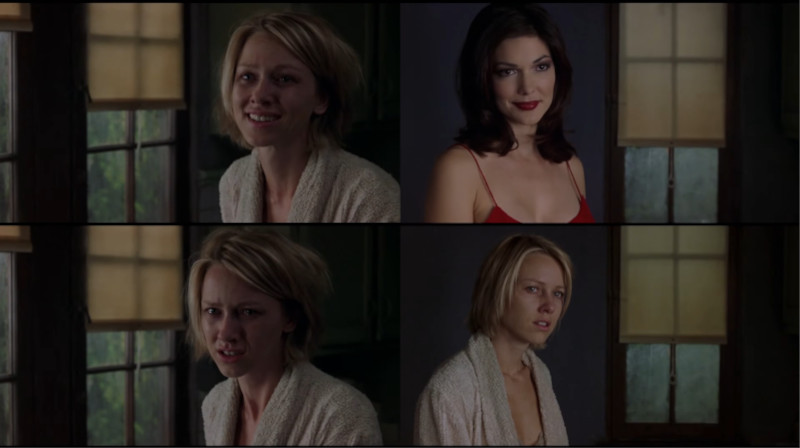
This whole sequence – and really, any point in the movie in which that tone sound gets used, like the wig-making scene – is highly disquieting. Anyone prone to maladaptive daydreaming can imagine what Diane is experiencing in this moment: the crushing come-down from a fantasy, and more pointedly for Diane, the sudden remembrance of circumstances. We are inside Diane's head for most of the movie, so this vision of Camilla is not totally unexpected. Yet, for this jarring, unusual cut to happen in the narrative's “reality” section throws us completely off. Like the rest of the fragmentary, non-sequential final section of the movie, the feeling of this scene is just as surreal as the apparent “dream place” we depart from after opening the blue box, maybe even more so. The labels of dream and reality applied to the first and second sections of the film make for a conveniently tidy explanation – but they have a tendency to peel away at the edges.